For most South Florida homes, blown-in fiberglass on the attic floor is the better value, and spray foam on the roof deck is the better performer when you need to seal air leaks and pull the ductwork into conditioned space. Blown-in is the better value on most South Florida attics, and it gets an older attic up to the recommended R-38 fast. Spray foam costs more, often $1.50 to $7.00 depending on open cell or closed cell, and it earns that price only when air sealing and duct location are the real problem. The right pick comes down to what your attic is doing wrong, not which product sounds premium. We are Florida Breeze HVAC, and we inspect, insulate, and service attics across Miami-Dade, Broward, and Palm Beach.
If you are pricing this out during the July and August peak, start with the money side in our 2026 Florida attic insulation cost guide, then use this comparison to choose the material.
Key takeaways
- Blown-in fiberglass or cellulose is the cheaper, faster way to bring a vented attic floor up to R-38, which ENERGY STAR lists as the low end of its attic recommendation for the southern United States.
- Spray foam wins on air sealing and R-value per inch. Closed cell hits about R-6 to R-7 per inch, but it makes sense mainly in an unvented, sealed-attic assembly.
- Blown-in runs about $1.00 to $2.50 per square foot installed; spray foam runs about $1.50 to $7.00 depending on open cell versus closed cell (general ranges, not a quote).
- Better attic insulation lowers the cooling load, so your air conditioner runs less and lasts longer.
- Both are professional installs. Blowing in depth, air sealing, and foam chemistry are not weekend jobs.
The short answer: which one most South Florida homes should choose and why
Most South Florida homes with a standard vented attic should choose blown-in insulation on the attic floor. It is the fastest, most affordable way to reach the recommended R-value, and it handles the uneven framing and old wiring found in older Miami-Dade, Broward, and Palm Beach houses. That covers the majority of the calls we run.
Spray foam is the better answer in a narrower set of cases: when air leaks are severe, when the ductwork and air handler live in the hot attic and you want them in conditioned space, or when a roof replacement opens the deck for a sealed-attic upgrade. In those homes, foam does something blown-in cannot, and it can be worth the higher price. For everyone else, paying spray-foam money for a simple depth problem is overkill.
How blown-in fiberglass and cellulose actually work in a hot attic
Blown-in insulation is loose material a professional blows across the attic floor to a measured depth, building a thick thermal blanket between your ceiling and the superheated attic above it. A South Florida attic can hit 130 to 150 degrees in summer, so this layer's job is to slow that heat before it reaches your living space.
Blown-in comes in two common materials, and they behave a little differently:
- Blown-in fiberglass gives roughly R-2.2 to R-2.9 per inch. It does not absorb water, it will not feed mold, and it holds its rating well over decades. It is the workhorse we install most often on attic floors here.
- Blown-in cellulose gives roughly R-3.2 to R-3.8 per inch, so it packs more resistance into the same depth. It is made from treated recycled paper. It performs well but needs a dry, well-detailed attic, since cellulose is more sensitive to moisture than fiberglass.
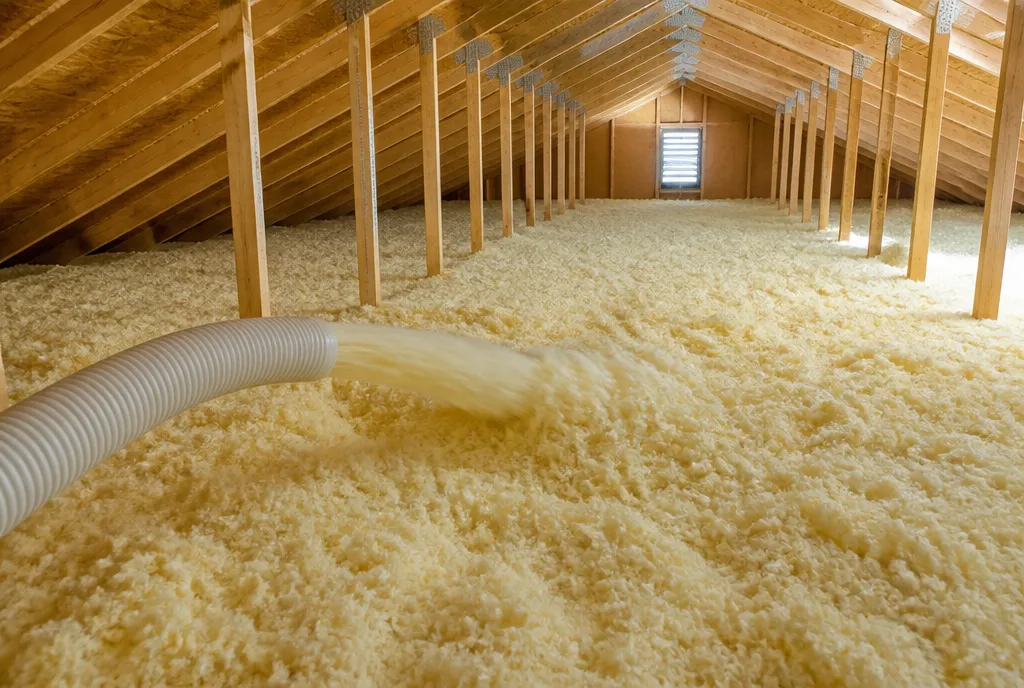
The mistake we fix most often with blown-in is depth. Insulation compresses over the years, and a lot of older attics we open sit at R-11 or R-19, well under target. Blown-in solves that fast: a crew can top it up to R-38 or higher in a few hours. What it does not do on its own is seal air leaks, since loose fill lets air pass through it. A good install pairs it with air sealing at the ceiling penetrations first.
How spray foam (open cell and closed cell) works, and when an unvented attic assembly makes sense
Spray foam is a two-part liquid that expands on contact and cures into a solid layer that both insulates and air seals. It is usually sprayed on the underside of the roof deck to create an unvented, sealed attic, which brings the whole attic, including your ducts, inside the cooled envelope of the house. That is the real reason to choose it in South Florida.
Spray foam comes in two types, and they are not interchangeable:
- Open-cell spray foam runs about R-3.5 to R-3.9 per inch. It is softer, expands more, and air seals well at a lower price than closed cell.
- Closed-cell spray foam runs about R-6 to R-7 per inch, the highest of any common attic material. It is dense, rigid, and doubles as an air and vapor barrier, which is why it is the usual pick for a sealed roof deck.
When an unvented attic makes sense: if your air handler and duct runs sit in the attic, sealing the roof deck pulls them out of that 150-degree oven. The Florida Solar Energy Center has documented that conditioning the attic this way can cut duct-related losses meaningfully, and less duct loss means your ductwork delivers more of the cold air you paid for.
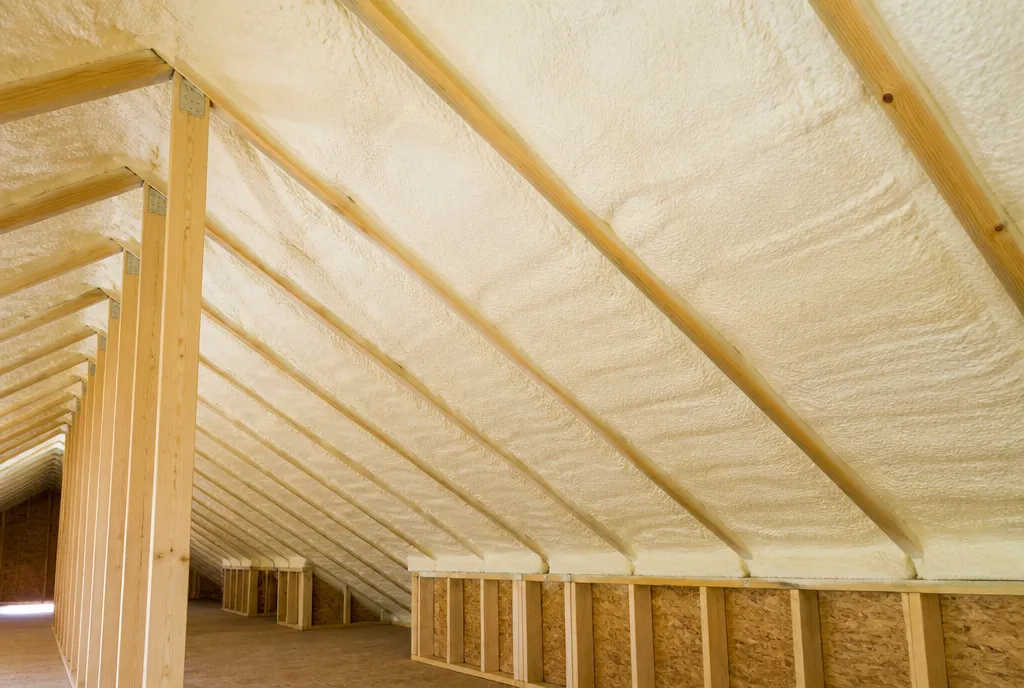
One honest caveat on moisture, since a sealed attic changes how the roof breathes. When you foam the underside of the deck, you remove the attic vents, so the assembly has to be detailed correctly and, in many cases, the attic needs a small amount of supply air or dehumidification to stay dry. Done right it is a proven assembly; done wrong it can trap moisture against the sheathing. This is exactly why closed-cell and unvented work belongs with a licensed contractor who builds the whole assembly, not just the foam.
Blown-in vs spray foam attic insulation: the head-to-head comparison
Here is the blown-in vs spray foam attic insulation comparison on the factors that actually change your comfort and your bill. Treat the costs as general South Florida ranges, not a quote.
| Factor | Blown-in (fiberglass / cellulose) | Spray foam (open / closed cell) |
|---|---|---|
| R-value per inch | R-2.2 to R-3.8 | Open cell R-3.5 to R-3.9; closed cell R-6 to R-7 |
| Air sealing | Low; needs separate air sealing | High; seals as it cures |
| Attic type it fits | Vented attic, on the floor | Unvented, sealed roof deck |
| Retrofit difficulty | Easy; blown over existing floor | Harder; best with deck access or a re-roof |
| Effect on cooling load | Good; cuts ceiling heat gain | Best when ducts are in the attic |
| Durability / settling | Fiberglass holds; cellulose can settle | Holds shape; does not settle |
| Maintenance | Check depth every several years | Almost none once sealed |
| Typical installed cost | $1.00 to $2.50 / sq ft | $1.50 to $7.00 / sq ft |

What each one costs in South Florida and what drives the price up or down
Blown-in insulation typically runs about $1.00 to $2.50 per square foot installed, and spray foam runs about $1.50 to $3.50 per square foot for open cell and roughly $3.00 to $7.00 for closed cell. On a typical 1,500-square-foot attic, blown-in often lands between $1,500 and $3,000, while a full closed-cell roof-deck job can run several times that. These are general ranges that shift with your home and the market, not fixed prices.
What pushes the number up or down:
- Removing old insulation first. Compressed, wet, or rodent-fouled material has to come out before new goes in, which adds labor.
- Target R-value. Reaching R-38 to R-49 takes more material than a thin top-up.
- Attic access and pitch. Tight, low, or cut-up attics slow the crew down.
- Open cell vs closed cell. Closed cell uses more material per inch and costs more.
- Air sealing and duct work. Sealing leaks or addressing ducts adds scope but usually pays back in lower cooling bills.
Timing matters this year. The Florida Public Service Commission approved Florida Power and Light's four-year rate agreement on November 20, 2025, and the new base rates took effect January 1, 2026. Per FPL, a typical 1,000-kilowatt-hour residential bill in most of Florida rose about 2 percent, from $134.14 to $136.64. With July and August being the heaviest cooling months in Southeast Florida, a right-sized attic upgrade is one of the clearer ways to take load off your air conditioner and blunt that increase. Whatever you choose, get a written, itemized quote before signing.
How to tell what you already have and whether you are below the recommended level
You can size up your attic in a few minutes without any risk. Grab a flashlight, open the attic hatch, and look, without climbing in or stepping off the framing. Loose, fluffy material spread across the floor is blown-in. A solid, sprayed-on layer following the underside of the roof is foam.
Then check depth. ENERGY STAR recommends roughly R-38 to R-49 for attics across the southern United States (Climate Zones 1 and 2). As a rough field check, blown-in fiberglass needs somewhere around 13 to 17 inches to reach R-38. If your insulation is only a few inches deep, sits below the tops of the floor joists, or you can see bare ceiling in spots, you are almost certainly under target. Our summer attic insulation guide walks through the other signs, like rooms under the roof that never cool down.
Other tells that you are short on insulation: cooling bills climbing faster than your neighbors', an AC that runs almost nonstop yet the house never feels cool, and ceilings that feel warm to the touch in the afternoon. Any one of those is worth an attic insulation inspection.
Why this is a job for a licensed professional, not a weekend project
Attic insulation is professional work, and the reasons are practical, not marketing. Blown-in has to go in at the right density and depth with the right machine, or you get uneven coverage and voids that leak heat. Air sealing means finding and sealing the ceiling penetrations that a rented blower will happily bury and hide. Spray foam is a chemical install with real safety and curing requirements, and a sealed, unvented attic is a building assembly that has to be designed as a whole so it stays dry.
A South Florida attic is also a hot, cramped space full of wiring, ductwork, and a ceiling you can step a foot through, and Florida expects insulation contractors to be licensed and insured. When in doubt, have a licensed pro assess it. We handle the inspection, the removal if it is needed, the air sealing, and the install, and we check your ducts while we are up there.
Frequently Asked Questions
Is spray foam or blown-in insulation better for a Florida attic?
For a standard vented attic, blown-in on the floor is usually the better value and reaches the recommended R-38 for less money. Spray foam is better when you need to air seal and pull attic ductwork into conditioned space, which suits a smaller share of homes.
What R-value do I need for an attic in South Florida?
ENERGY STAR recommends roughly R-38 to R-49 for attics across the southern United States (Climate Zones 1 and 2). Many older Southeast Florida attics sit at R-11 or R-19, well below that, which is why topping up to R-38 or higher makes such a noticeable difference.
How much does spray foam attic insulation cost compared to blown-in?
These are general South Florida ranges, so get a written, itemized quote for your home.
Does attic insulation lower cooling costs?
Yes. Better attic insulation cuts the heat coming through your ceiling, so your air conditioner runs less and uses less power. A well-insulated attic often trims cooling costs by 15 to 25 percent, and it eases wear on the AC system.
Can I add spray foam over existing blown-in insulation?
Not directly. Spray foam belongs on a clean roof deck for a sealed attic, not on top of loose blown-in on the floor, so mixing them usually means removing the old material first, which carries its own removal cost. A contractor should inspect the attic and tell you which approach fits.
Florida Breeze HVAC: attic insulation in Miami, Broward, and Palm Beach
Florida Breeze HVAC installs and services attic insulation across Miami-Dade, Broward, and Palm Beach, alongside AC repair, duct cleaning, and duct replacement. We look at what is actually in your attic, tell you whether blown-in or spray foam fits your home, and give you a straight quote before any work starts.
Call us at 954-687-8624 or request a free estimate online. We serve Miami-Dade, Broward, and Palm Beach County.
$0 Down Financing
No credit needed. Everyone approved.
Start the work now and pay over time.
954-687-8624Related Articles
Explore Our HVAC Services
Serving Miami, Broward, and Palm Beach, ask about our $0 down financing, no credit needed, everyone approved.
Need HVAC Service?
Florida Breeze HVAC serves Miami, Broward, and Palm Beach with fast, professional service.