
Blown-in fiberglass on the attic floor is the best attic insulation for most Florida homes. Air ducts change that. In most homes here, the air ducts run through the attic. A blanket on the floor below leaves them in the heat, so it costs you money every month.
That heat is worse than it sounds. The Florida Solar Energy Center measured a test attic at 135.6 degrees in July. Your air conditioner works against that heat all day.
The same study found a system can lose up to 30 percent of its power to a hot attic. You pay for that loss in every bill.
We will walk you through it step by step, so by the end you will know where your ducts sit, how deep your insulation is, which material belongs in a Southeast Florida attic, and what to seal first.
Our guide to attic insulation cost in Florida explains what sets the price, and attic insulation removal cost covers an attic full of old material.
What is the best attic insulation for a Florida home?
Blown-in fiberglass across the attic floor, built up to R-30, is the best attic insulation for most Southeast Florida homes. Short answer, since that is why you came. R-value is the number that says how well a material slows heat down, and a higher number slows it more.
The best attic insulation for hot climates does two jobs: it slows the heat, and it shrugs off water. Here is how the four choices rank:
- Blown-in fiberglass: right for most homes, cheapest to install, and it does not soak up water.
- Closed-cell foam under the roof: right when the ducts live in the attic, and it costs the most by a wide margin.
- Blown-in cellulose: it insulates well and it holds water.
- Fiberglass rolls: cheapest to buy, easiest to leave gaps in.
That R-30 is not a round number somebody picked. Broward, Miami-Dade and Palm Beach counties sit in climate zone 1, the hottest band Florida's energy code splits the state into, and the code asks ceilings in that band for R-30. The rest of Florida sits in zone 2, where the number is R-38. So a quote telling a Fort Lauderdale homeowner the code wants R-38 is quoting the wrong zone.
That number is only half of it. Your ducts decide whether it applies to you, so start there.
Step one) Where do your air ducts and air handler sit?
The air handler is the indoor cabinet that blows your cold air, and in most Southeast Florida homes it sits in the attic with the ducts. The ducts are the silver or gray flexible tubes carrying that air to your vents. Open the attic hatch and check.
Insulation on the attic floor does nothing for a duct hanging above it, and the cold air inside that duct warms up before it reaches a vent.
The fix is to insulate the underside of the roof instead. Most attics here are vented, which means the eaves carry slots that let outside air blow through. Closed-cell foam sprayed on the roof deck seals those slots. The attic then joins the cooled space inside your house, and your ducts sit in a room near house temperature.
The picture below sets the two jobs side by side: foam under the roof when the ducts are in the attic, fiberglass on the attic floor when they are not.

If the air handler sits in a closet or the garage, put the money on the attic floor. Either way, the next question is how much is up there already.
Step two) How deep is the insulation you already have?
A tape measure tells you how deep it is, and nothing else does. Push the tape down to the ceiling in three or four spots, away from the hatch. The depth gives you the attic insulation R-value you own today.
For loose fiberglass, the Department of Energy puts it at depth in inches times 2.5. For cellulose, the gray shredded paper kind, it is depth times 3.7.
So 4 inches of fiberglass reads about R-10. The code asks ceilings here for R-30, which puts that attic a third of the way there. If you leave it at 4 inches, you pay to cool two thirds of that heat back out again, every month of the year.
Fiberglass lying level with the ceiling joists, the wood beams under your attic floor, is about 4 inches deep.
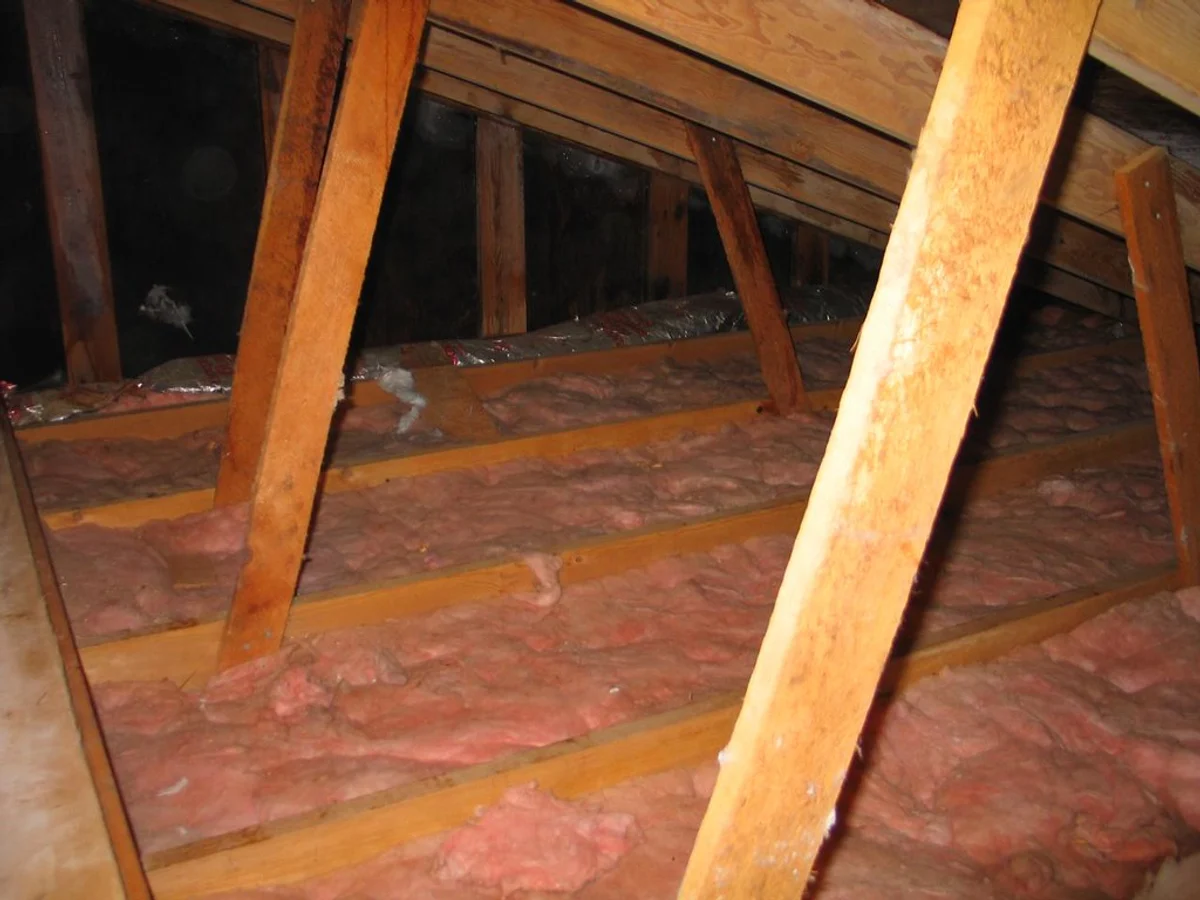
That depth decides how much attic insulation to add. Energy Star publishes the amount to add on top of what is already there: R-30 over a bare zone 1 ceiling, R-25 over one that already holds 3 or 4 inches.
Read that second number twice, because most quotes get it backward. You are adding R-25 on top of the inches already up there, which finishes the attic near R-35.
Step three) Which material belongs in a Southeast Florida attic?
Blown-in fiberglass belongs on the attic floor, and closed-cell foam on the roof deck when the ducts are up there. The four types of attic insulation you will be quoted differ in two ways: the inches to reach R-30, and what happens when the roof leaks. The Department of Energy publishes the R-value each one gives per inch.
| Material | R-value per inch | Inches to reach R-30 on the floor | What to know in Florida |
|---|---|---|---|
| Blown-in fiberglass | 2.5 | About 12 inches | It shrugs off water and it costs the least to install. It settles a little, so ask for depth marks. |
| Blown-in cellulose | 2.9 to 3.4 | About 9 inches | Fewer inches for the same R-value. The Department of Energy warns it can soak up large amounts of water and grow mold. |
| Fiberglass rolls | 2.9 to 3.8 | About 9 inches | The cheapest material to buy. Every gap between two rolls is a hole in the blanket. |
| Closed-cell foam on the roof deck | 7 to 9 | Not used on the floor | The only choice that cools ducts in the attic. It also hides a roof leak until the ceiling stains. |
One pairing does not work, and plenty of homeowners get sold both. A radiant barrier is foil stapled under the roof to bounce the sun's heat back out, and the Department of Energy says it is cost-effective in hot climates but not for use in an unvented attic.
Foam on the roof deck makes your attic unvented, so you pick one of the two. Pick foil for a vented attic with the ducts below the ceiling, foam for an attic with the ducts in it.
Both go in after a step most quotes skip over.
Step four) What do you seal before you add anything?
Seal five openings before any new insulation goes in: the recessed ceiling lights, the bathroom fan, the attic hatch, the pipe holes and the wire holes. Insulation slows heat down, and it does nothing at all to stop air.
The published savings come from sealing, not from insulation alone. The Department of Energy puts the figure at up to 20 percent of a home's heating and cooling costs. That number covers sealing and insulating together.
If your ducts run through the attic, seal those too. A leaking joint dumps cold air into the attic and pulls hot attic air back in. Our guide on repairing or replacing ductwork covers which one your ducts need.
Ask any installer to quote the sealing as its own line. If you skip it, a crew blows new insulation over open can lights and buries the cheapest part of the job.
What this costs, and what you get back
Blown-in fiberglass on the attic floor is the lower-priced job. Closed-cell foam on the roof deck costs several times more on the same house. Our attic insulation cost guide covers what moves the price. Four things move it: attic size, the material, the depth you need, and how much old insulation has to come out first.
Foam costs more because of the ducts, not the blanket. You can rent the machine and blow a floor job yourself, and the hardest part is crawling the edges where the roof meets the wall. Foam is never a weekend job.
Once that is done, two things change that you can feel. The back bedrooms stop running three or four degrees warmer than the living room. Your air conditioner runs cooler through the afternoon and shuts off instead of grinding until dark.
How we handle an attic insulation job
Florida Breeze HVAC holds Florida license CAC1823982 and works across Miami-Dade, Broward and Palm Beach. We go up with a tape measure and a flashlight before anybody quotes a material, because your depth and your ducts decide the job.
You get three numbers written down: the measured depth, the R-value it works out to, and the amount to add. We quote the sealing on its own line, so you can see what each part costs.
If your ducts are up there, we say whether sealing them beats foaming the roof. The written estimate is free, and we book attic insulation around your day.
FAQ
Can I put new insulation over the old insulation?
Yes, as long as the old layer is dry and still fluffy. Use unfaced material, with no paper or foil backing on it. The Department of Energy says to use unfaced batts in climate zones 1 through 4, and Southeast Florida is zone 1. A second backing between two layers traps water in the middle.
Does a radiant barrier replace insulation?
No. The foil bounces heat back out, and it has no R-value of its own. The Department of Energy lists its R-value as not applicable for that reason. A radiant barrier over a bare ceiling leaves you with a bare ceiling.
Does attic insulation actually help in the summer?
It helps most in the summer. The attic is hottest then, and your air conditioner runs the longest hours of the year against it. Our post on attic insulation in the summer goes through the heat path room by room.
Key takeaways
- Your ducts pick the job. Ducts in the attic point to foam on the roof deck, ducts below the ceiling to the attic floor.
- Measure the depth first. Fiberglass depth times 2.5 gives the R-value you own.
- Southeast Florida is climate zone 1. The code asks ceilings here for R-30, not the R-38 the rest of the state follows.
- Seal the ceiling holes first. Insulation blown over an open recessed light leaves the hole open.
Send us a photo of your attic along with the depth you measured. We will tell you what it works out to before anybody quotes you. Request a free written estimate or call 954-687-8624.
$0 Down Financing
No credit needed. 0% interest.
Payments as low as $29 a month. Start the work now and pay over time.
954-687-8624Related Articles
Explore Our HVAC Services
Serving Miami, Broward, and Palm Beach, ask about our $0 down financing, 0% interest, no credit needed, payments as low as $29 a month.
Need HVAC Service?
Florida Breeze HVAC serves Miami, Broward, and Palm Beach with fast, professional service.