A storm is coming and you have a long list to get through. Shutters, gas, water, batteries, patio furniture in the garage. Most people never think about the air conditioner. Then the storm passes, the power comes back on, and the house is already at 88 degrees. You turn the thermostat down and the unit outside does nothing. Now you need a repair in the week when every air conditioning company in the county is booked solid.
Yes, turn the air conditioner off during a hurricane. Shut it down at the thermostat first, then at the breaker, before tropical storm force winds reach you. Leave it off until someone has looked the outdoor unit over. The wind is not usually what breaks an air conditioner here. The bigger risk is the power going out and coming back on. We do AC repair and AC maintenance in Miami-Dade, Broward, and Palm Beach, so we see both kinds of call after a storm. Some units were shut off properly and only need switching back on. Others ran through the storm and need a part. By the end you will know when to shut yours off and at which switch, five things to do outside before the wind starts, four things to never try after the storm, and which parts of a flooded unit have to be replaced.
One note on this season. NOAA updated its outlook on August 6, 2026. It still expects a slow Atlantic season, 7 to 13 named storms, with a 75 percent chance of below normal activity because El Nino is holding storms down. That is good news, but it does not tell you much about your own house. NOAA says plainly that the outlook is not a landfall forecast, and it only takes one storm on your street.
Key takeaways
- Shut down at the thermostat first, then at the breaker. The thermostat alone leaves the wiring live.
- Let the hurricane warning be your clock. The National Weather Service puts one out 36 hours before tropical storm force winds arrive, so you have time to finish.
- Rain on the outdoor unit is normal. Water rising into the control box is not. That is the line between "turn it back on" and "do not touch it."
- Salt water is worse than rain. The National Electrical Manufacturers Association (NEMA) says ocean water and salt spray do more harm, because the salt left behind both eats metal and carries current.
- Some flooded parts get replaced, not dried. Contactors with electronics, control boards, overload relays, breakers, and fuses are all on NEMA's replace list.
When to turn the AC off, and which switch to use
Shut the system down before the wind arrives, not during it. The National Weather Service puts out a hurricane warning 36 hours ahead of tropical storm force winds. Those are steady winds of 39 to 73 mph. A watch comes earlier and means the storm might hit you. Treat the watch as the day you do the outside work. Treat the warning as the day the system goes off.
Cool the house down hard first. Drop the thermostat a few degrees below normal in the hours before you shut down. The walls, floors, and furniture hold that cold. It is the only air conditioning you get until the lights come back.
Then use both switches. Set the thermostat to off. Go to the panel and switch off the breaker for the air handler and the breaker for the outdoor unit. Most South Florida homes also have a pull-out box on the wall beside the outdoor unit. That box is the disconnect, and a technician will pull it too.
The breaker matters because of what happens when the power comes back. Ready.gov, run by the Federal Emergency Management Agency (FEMA), says to "turn off or disconnect appliances, equipment, or electronics," because "power may return with momentary surges or spikes that can cause damage." In a hurricane the power rarely goes out just once. It dips, cuts out, comes back for a few seconds, and cuts out again. Each time it returns, the compressor is asked to start against pressure that has not settled yet. Enough of those and you are paying for a new compressor after a storm that never touched your roof.
5 things to do outside before the wind starts
Most storm damage to an outdoor unit comes from things that were already sitting in the yard. Ten minutes of cleanup before the wind picks up prevents most of it.
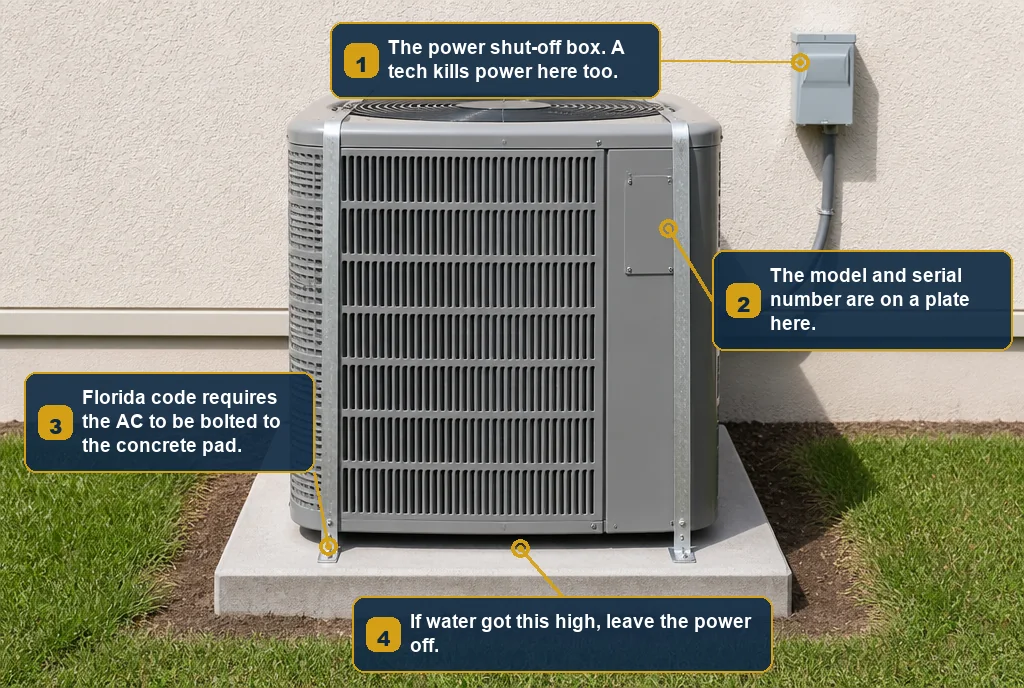
- Clear a wide circle around it. Potted plants, coconuts, loose pavers, the grill, garden tools, and storm panels leaned on the house all fly at 60 mph. The fan grille and the thin metal fins dent from almost nothing. Give it three feet of clear ground on every side.
- Check that it is still bolted down. Florida requires it. The Florida Building Code, Mechanical, Section 301.15 says equipment out in the wind has to be installed so the wind cannot move it. On a home system that means the unit is bolted to its concrete pad. Look for the bolts and brackets at the base. If they are missing or rusted through, or the pad has sunk and cracked, call a contractor. The anchors have to be rated for your address.
- Leave the cover off unless the power is already off. Plenty of storm advice online says to tarp the unit or box it in plywood. Loose plywood in a hurricane is a missile. And a wrapped unit that gets switched on has nowhere to send its heat. If you cover it, do it after the breaker is off, use a fitted cover that straps down, and pull it before anyone restarts the system.
- Take pictures and write down the model and serial number. Shoot all four sides in good light while it is still dry. The metal plate on the side carries both numbers. For a claim later, a dated before picture beats anything you write from memory.
- Know how low the pad sits. If your unit sits at ground level where water came up in a past storm, raising it is a job for a calm week in spring. It is not a job for the 36 hours before landfall. Make the note now.

4 things to never try after the storm
These four mistakes are the expensive ones, and the first three are dangerous on top of that.
- Never flip the breaker on a unit that sat in water. If there is standing water around the unit, or a water line above the base of the cabinet, leave the power off until a technician has opened the control box. NEMA is blunt about this. Equipment that has been in water "can be extremely dangerous if reenergized without proper reconditioning or replacement." Switching it on risks a shock to you and a short circuit inside the unit.
- Never try to dry a flooded unit out yourself. Hosing it down, blowing a fan at it, or leaving it in the sun for three days does not make wet electrical parts safe. It hides the problem long enough for the unit to run a week and then quit. NEMA also warns that cleaning equipment without asking the maker first can cause new problems, because the wrong cleaner does more damage.
- Never run the AC off a portable generator plugged into the house. Power fed backward into your outlets can kill the utility crews on your street and start a fire in your walls. A central system runs on 240 volts and pulls a big jolt at startup, so it needs a standby generator sized for it. A licensed electrician wires that through a transfer switch. Keep the generator outside. Ready.gov says generators and fuel go outdoors, at least 20 feet from windows, doors, and attached garages, with working carbon monoxide alarms on every floor.
- Never let anyone add refrigerant who cannot show a certification. Under U.S. Environmental Protection Agency rules at 40 CFR Part 82, techs who service or scrap gear that can release refrigerant have to hold Section 608 certification. Topping off refrigerant is not a storm fix anyway. If the charge is low, something is leaking, and the leak is the job.

What gets replaced on a flooded AC, and what does not
A wet air conditioner is not automatically a ruined one. The outdoor unit is built to stand in the rain, so a unit that got soaked from above is usually fine once it dries. The trouble is water that came up from below and got into the box where the contactor, the capacitor, the control board, and the wire connections sit.
Once water gets in there, some parts have to come out no matter how good they look. NEMA's guide on water damaged electrical equipment says replacement will be needed in many cases. It names the motor circuit parts that have to be replaced rather than cleaned: contactors and starters with electronic controls, any part holding semiconductors and transistors, overload relays, molded case breakers and switches, and fuses. That is most of the control side of a modern air conditioner. The same guide says wet ground fault outlets and surge protectors "are not suitable for continued use and must be replaced." It says not to air dry or wash them.
Motors are the exception. The fan motor and the compressor get tested before anyone decides. NEMA says a flooded motor can lose its insulation and take damage to switches, contacts, capacitors, and overload protectors, and that metal parts rust and the oil gets dirty. A qualified technician has to test it and check with the manufacturer first.
Salt water is a harder case. If your unit took storm surge or heavy salt spray instead of rain, fewer of the parts are worth saving, and the repair bill climbs fast. At that point it is usually worth pricing out a new system before you agree to rebuild the old one.
How to turn the AC back on once the power is steady
Wait until the power has been on and holding steady for a while. The first time it comes back is not the time to restart your air conditioner. Once it is stable, here is the part you can safely do yourself.
Look at the unit in daylight. Check four things. Is there standing water around it or inside it? Is there debris packed into the coil or against the fan? Has the cabinet shifted or lifted off its pad? Do you smell anything burnt? If all four are clear, switch the outdoor breaker and the air handler breaker back on. Wait five minutes without touching the thermostat. Then set it to cool and give it another five. Many systems hold the compressor off for a few minutes on purpose, so a pause is normal.
Stop and call a licensed pro if the breaker trips again, you smell burning plastic, you hear loud buzzing with no fan turning, the fan turns slowly or not at all, there is water in the electrical box, or a fan blade is bent. Never reset a breaker a second time. It tripped because something down the line is wrong, and the breaker is doing its job.
Water pouring out of the indoor unit after a storm is often a different problem. Days off in wet weather, then a hard restart, will overflow a drain line that was already half blocked. Our guide on a clogged AC drain line covers that. If it runs but the house never gets cold, start with why an AC runs without cooling.
Two Florida laws worth knowing before you hire anyone
After a storm, trucks show up in neighborhoods with no signs on the door and cash prices. Florida has two laws that cover this situation, and most homeowners have never heard of either one.
Unlicensed work during a declared emergency is a felony. Under Florida Statute 489.127, an unlicensed person who does contracting work while the Governor has declared a state of emergency commits a third degree felony. Outside an emergency, a first offense is only a misdemeanor. You can check any license number in a minute at the Florida Department of Business and Professional Regulation. Ask for it before the panel comes off your unit, not after.
Price gouging is illegal once an emergency is declared. Florida Statute 501.160 makes it unlawful to sell needed goods and services at an unfair price during a declared state of emergency. The law calls a price unfair when it is far above what the same thing sold for in the 30 days before the emergency was declared. A seller can answer that by showing their own costs went up, or that the whole market moved. Get the price in writing either way. Our guide to choosing an HVAC contractor in South Florida covers what else to ask.
Florida Breeze HVAC is a licensed Florida heating and air conditioning contractor, license CAC1823982, serving Miami-Dade, Broward, and Palm Beach counties. There are only three things a homeowner needs to do here. Clear the yard, shut the system down at both switches, and look it over before switching it back on. Everything past that is licensed work for a reason.
FAQ
Can I run my AC during a hurricane?
Not once the wind picks up and the power starts cutting out. Running through repeated outages is what damages compressors and control boards. Cool the house down early instead, then shut the system off at the thermostat and the breaker.
Should I cover my AC unit during a hurricane?
Only if the power is already off at the breaker, and only with a fitted cover that straps down. Plywood and loose tarps turn into flying debris. A covered unit that gets switched on cannot release its heat. Clearing the yard around it protects it more than covering it does.
Can I run my central air conditioner on a generator?
Only on a standby generator sized for the system and wired through a transfer switch by a licensed electrician. A central unit runs on 240 volts and pulls a big surge at startup, so most portable generators cannot carry it. Never plug a generator into a wall outlet to feed the house. Keep it at least 20 feet from windows, doors, and attached garages, as Ready.gov advises.
My AC ran through the storm and now it will not start. What happened?
The usual causes are a tripped breaker, a failed run capacitor, a burned contactor, or a control board hurt when the power came back. Debris in the coil and a bent fan blade are close behind. Our guide on checking an AC capacitor covers that part, though testing and changing one is a job for a pro.
Does homeowners insurance cover a flooded AC unit?
It depends on how the water got there, and the answer is in your own policy. Florida homeowners policies usually leave out flooding, which is why flood coverage is a separate policy through the National Flood Insurance Program. Wind damage usually falls under the homeowners policy, with its own hurricane deductible. Take pictures, keep the model and serial number, and call your agent before you approve any repairs.
Get your system checked before the next storm
The best time to find a rusted strap, a sunken pad, or a weak capacitor is on a clear day. Not the afternoon a warning goes up. We check the outdoor unit, the electrical connections, and the drain line, and we put anything that needs work in writing before it starts, at no charge, anywhere in Miami-Dade, Broward, and Palm Beach. Get a Free Evaluation or call 954-687-8624.
$0 Down Financing
No credit needed. Everyone approved.
Start the work now and pay over time.
954-687-8624Related Articles
Explore Our HVAC Services
Serving Miami, Broward, and Palm Beach, ask about our $0 down financing, no credit needed, everyone approved.
Need HVAC Service?
Florida Breeze HVAC serves Miami, Broward, and Palm Beach with fast, professional service.