For most South Florida homes, a central air conditioner is the better choice when the house already has good ductwork and you want one system to cool the whole place, while a ductless mini-split wins for a single room, an addition, a converted garage, or any home with no existing ducts. Both cool well in our heat and humidity when sized and installed right. If your current unit is failing, this pairs with our guides on whether to repair or replace your AC and what AC replacement involves in South Florida. This ductless mini-split vs central AC guide walks through how each one works, where each one shines, what each costs to install and run, and how to pick the right one for your house before the next heat wave forces the decision for you.
Key takeaways
- Central AC cools a whole house through ducts; a ductless mini-split cools room by room with a small wall or ceiling unit and no ductwork.
- Both handle South Florida heat and humidity well when they are correctly sized and professionally installed, so the right pick depends on your home, not on cooling power alone.
- A mini-split is usually the best AC for a Florida home without ductwork, plus additions, garages, and single rooms; central AC is usually best for whole-home cooling in a house that already has good ducts.
- Mini-splits often post higher efficiency numbers (measured in SEER2, the federal rating in effect since January 2023 per the U.S. Department of Energy), but a modern central system with sound ductwork can run efficiently too.
- Every figure below is a general estimate that varies by home and job, not a quote. Get a written, itemized estimate before you decide, and leave all install, refrigerant, and electrical work to a licensed professional.
What each system is and how it works
A central air conditioner cools your entire home from one system and pushes the cold air through a network of ducts; a ductless mini-split cools individual rooms directly, with no ducts at all. That single difference, ducts or no ducts, drives almost everything else in this comparison.
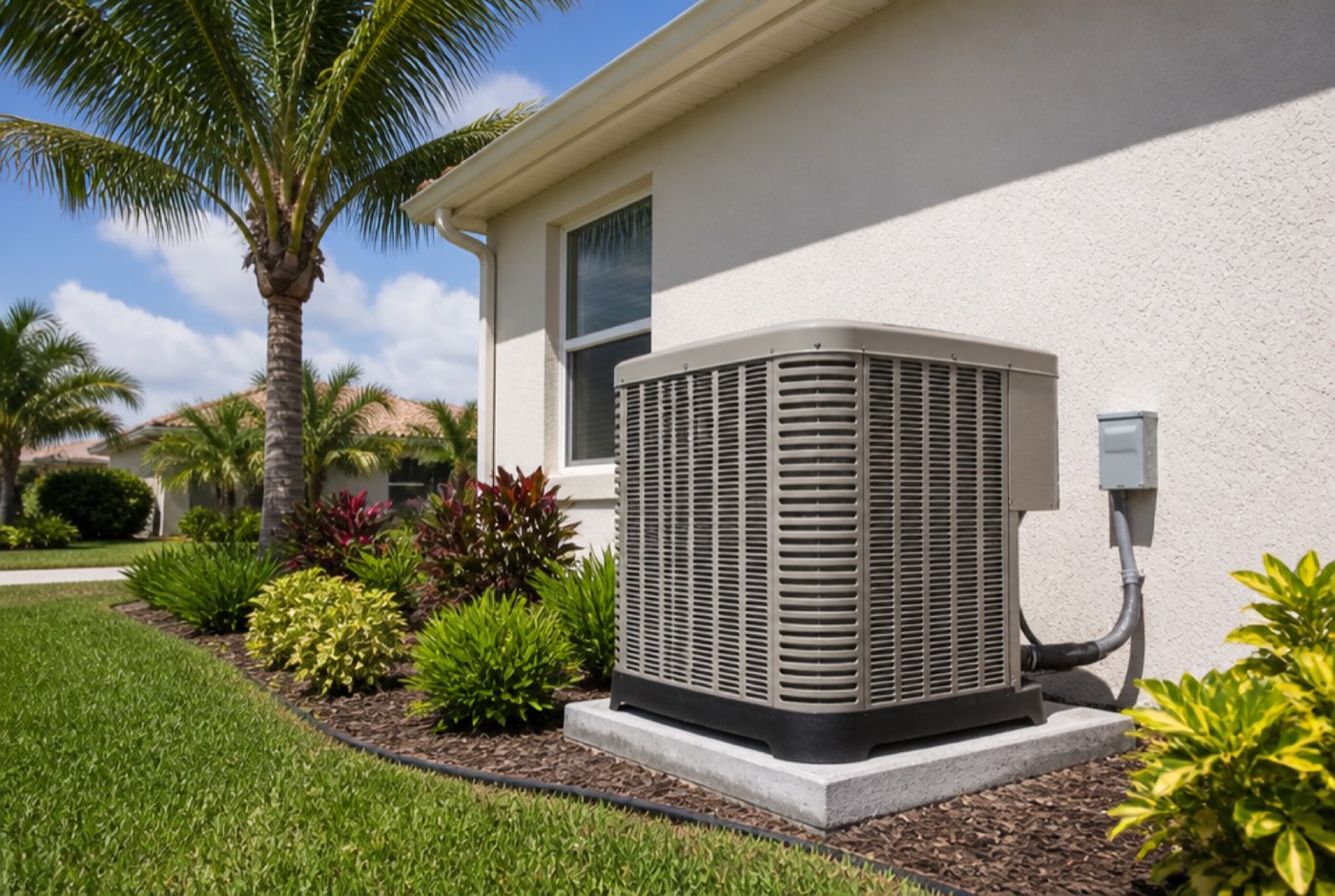
A central AC has two main parts. The "condenser" (the big outdoor unit that releases heat) is outside next to the house, and the "air handler" (the indoor blower that moves cold air) is in a closet, attic, or garage. The air handler pulls warm air in through a return, cools it across a cold coil, and blows it back out through "ductwork" (the network of metal or insulated channels that carries air to each room). One thermostat sets the temperature for the whole home.
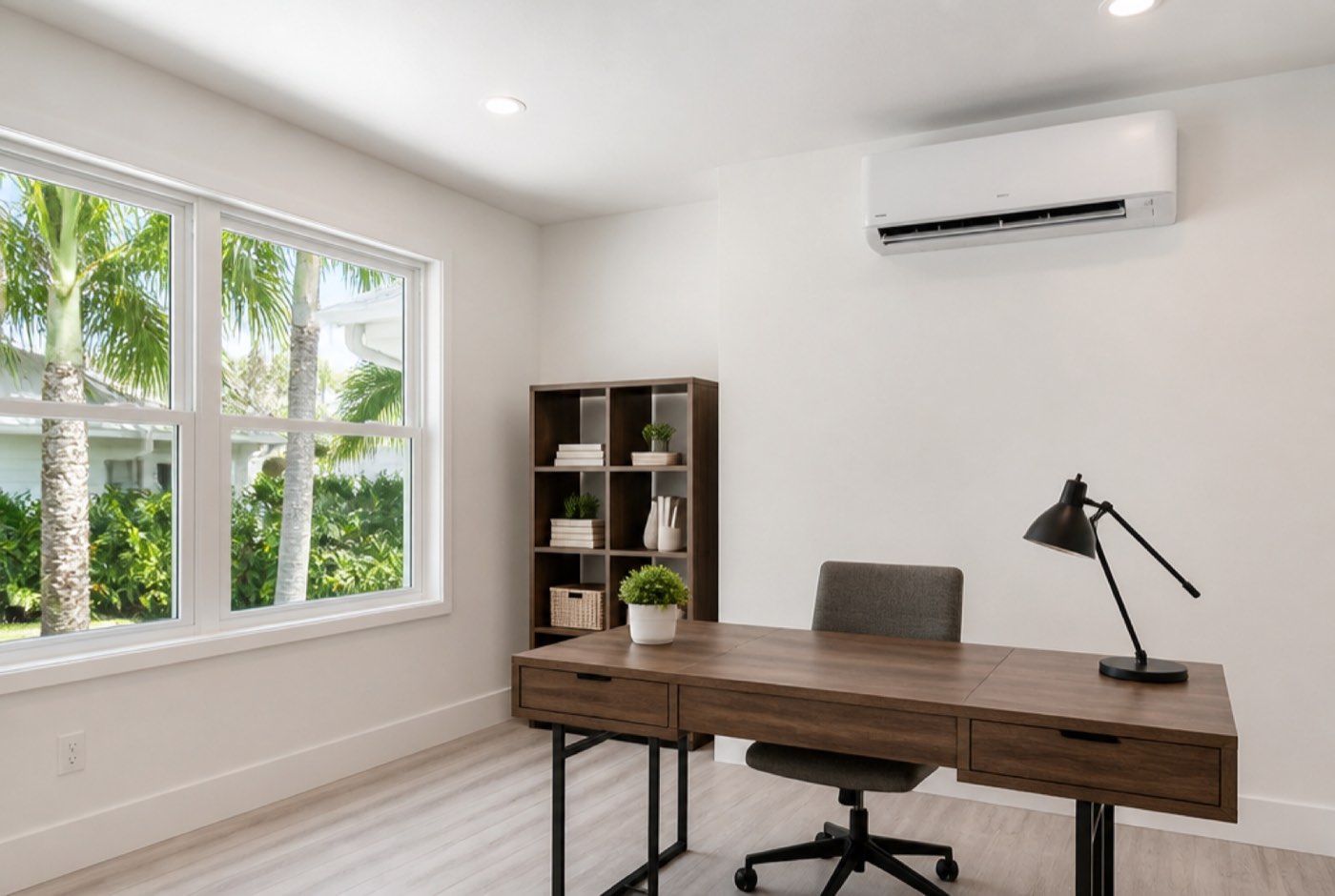
A ductless mini-split ("mini-split" meaning a small split system with no ducts) also has an outdoor condenser, but instead of an air handler feeding ducts, it connects by a slim refrigerant line to one or more indoor units mounted high on a wall or ceiling. Each indoor unit, often called a head, cools the room it is in and usually has its own remote and temperature setting. One outdoor unit can run several heads, which is how a mini-split can cool multiple rooms while still skipping ducts entirely.
Mini-split pros and cons
A ductless mini-split's biggest strength is flexibility: it cools spaces central air struggles to reach, without tearing open walls to add ducts. Its main trade-off is that cooling a whole house takes several indoor heads, and those visible units are not for everyone. Here are the honest ductless AC pros and cons for a South Florida home.
Where mini-splits win. They are the natural answer for a room that never gets cold enough, a new addition, a converted garage or attic office, a Florida room, or any older home that was never built with ducts. Because there are no ducts, you avoid the air that leaks and wastes through duct gaps, a real loss in attics that bake all summer here. Each head cools only the room in use, so you are not paying to cool empty bedrooms. Mini-splits also tend to post strong efficiency numbers and run quietly, and many models both cool and heat for the handful of cold mornings the region sees.
Where mini-splits fall short. Cooling a whole house means mounting an indoor head in most rooms, and some homeowners do not like the look of units on the wall. The upfront cost climbs fast once you need four, five, or six heads. Each head has its own filter to keep clean, and a multi-room job still needs careful, professional sizing so one outdoor unit is not overloaded. For a large home that already has solid ductwork, a wall of mini-split heads is often more hardware than the situation calls for.
Central AC pros and cons
Central air's biggest strength is even, whole-home cooling from one quiet system you barely see; its main trade-off is that it depends entirely on ductwork, which many older South Florida homes do not have or have let go. Here is the fair view.
Where central AC wins. One thermostat, one system, and cool air in every room with only a vent visible on the wall or ceiling. For a home that already has good ducts, central AC is usually the simplest and most cost-effective way to cool the whole place, and it keeps the temperature even from room to room. The indoor equipment is tucked out of sight, and a central system pairs cleanly with whole-home air filtration and a dehumidifier, which matters a lot in our humidity. When people picture a typical case of central air conditioning in a South Florida home, this is it.
Where central AC falls short. No ducts, no easy central AC, and adding ductwork to a finished older home is a major, costly project. Air can also leak from old or poorly sealed ducts, which wastes cooling and money, and because one thermostat runs the whole home you get less room-by-room control. When part of the house feels warm or the bills creep up, ducts are often the hidden culprit, which is why a duct check is part of any honest replacement conversation.
Cost comparison: install and running costs
As a rough rule, a single-room mini-split is the cheaper project, a whole-home central system is the mid-range project, and a whole-home multi-head mini-split is often the most expensive of the three. Running costs usually favor whichever system is efficient and not fighting leaky ducts. Treat every number here as a general estimate that varies by home, equipment, and the job itself, not a price quote.
Install cost. Cooling one room or an addition with a single mini-split head is typically the lowest-cost way to add real cooling, since there is no ductwork to build. Replacing a central system in a home that already has ducts is a larger but well-understood job. Going ductless for an entire house, where you need an indoor head in most rooms, can match or pass the cost of central air once you add up all the heads and the labor to mount and connect each one. Two homes can land at very different numbers depending on layout, electrical, the number of zones, and the condition of any existing ducts. For real South Florida ranges on the central side, our Florida AC replacement cost guide breaks down what drives the price.
Running cost. The question we hear most is whether a mini-split is cheaper to run, and the honest answer is "often, but not always." Mini-splits avoid duct losses and cool only the rooms in use, which saves energy in the right home. But a modern, efficient central system with well-sealed ducts can run efficiently too, and a whole-home mini-split running every head all day is not automatically cheaper than good central air. Efficiency is rated in SEER2, the federal standard in effect since January 2023, per the U.S. Department of Energy; a higher SEER2 number means lower running cost for the same cooling, on either system, and our guide to whether a higher SEER2 rating is worth the extra cost shows what each tier saves here. New equipment built since 2025 also uses lower global-warming refrigerants such as R-454B, and our guide to R-454B vs. R-410A covers what that means when you are pricing either system.
Because the spread is so wide and so personal to your house, the smart move is to get a written, itemized quote that spells out equipment, labor, electrical, and any duct work, so you are comparing real numbers for your home rather than averages. We never publish a one-size price as a guarantee, and neither should anyone else.
Ductless mini-split vs central AC: the head-to-head
Side by side, central AC leads on whole-home simplicity and hidden equipment, while a ductless mini-split leads on no-duct flexibility and room-by-room control. Here is how the two compare on what actually matters in a hot, humid South Florida home, never on a fixed price.
| What matters | Ductless mini-split | Central AC |
|---|---|---|
| Cooling in extreme heat and humidity | Strong per room when sized right; dehumidifies well | Strong whole-home; pairs easily with added dehumidification |
| Best for | Rooms, additions, garages, homes without ducts | Whole-home cooling where good ducts exist |
| Installation | No ducts needed; one head per room to cool | Uses existing ducts; adding ducts is a big job |
| Efficiency and energy use | High SEER2 common; no duct loss; cools only used rooms | Efficient when modern with sealed ducts; duct leaks hurt |
| Indoor air quality | Per-head filters; no shared duct path to spread dust | Central filter and whole-home filtration options |
| Appearance | Visible indoor head in each cooled room | Only vents show; equipment hidden away |
| Lifespan | Long with upkeep; coastal salt air shortens any system | Long with upkeep; coastal salt air shortens any system |
| Maintenance | Clean each head's filter; pro tune-ups | One central filter, plus ducts to keep sealed; pro tune-ups |
Notice that neither system "loses" on cooling power. In a salt-air coastal climate, the bigger driver of lifespan and efficiency on either system is correct sizing, professional installation, and regular maintenance, not the format you pick. The core components that affect cooling performance are similar on both.
Best fit by home type and scenario
The fastest way to decide is to match the system to your situation. Here is how it usually shakes out across the most common South Florida homes.
- House with good existing ductwork: central AC is usually the best fit, simplest to live with, and cleanest to maintain. A duct check and an efficiency upgrade often beat switching formats.
- Older home with no ductwork: a ductless mini-split is typically the best AC for a Florida home without ducts, since you skip the cost and disruption of building duct runs into finished walls.
- New addition, Florida room, or bonus space: a single mini-split head cools the new space without overloading or re-sizing the central system.
- Converted garage or attic office: a mini-split handles these hot, hard-to-duct spaces well and lets you set a temperature just for that room.
- One room that never gets cold enough: a single head fixes the comfort gap for far less than re-doing the whole system.
- Large home, multiple zones, owners who want hidden equipment: central AC, or a hybrid of central plus a mini-split for one problem area, is often the most practical mix.
How to decide
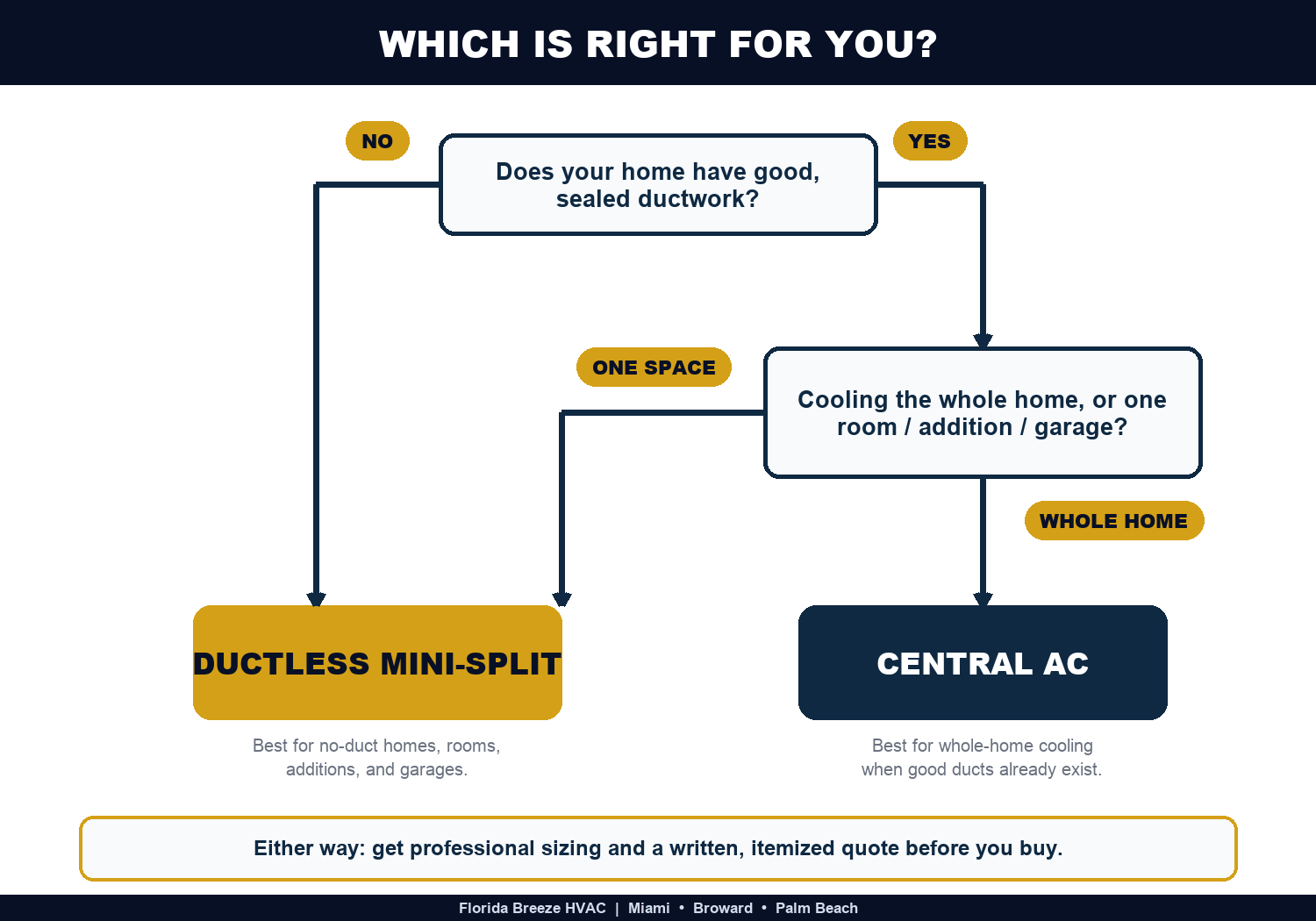
Decide by answering three questions in order: Do you have good ductwork? Are you cooling the whole home or one space? And what does an itemized quote for each option actually show for your house? If you already have sound ducts and want whole-home comfort, central AC is usually the answer, and your next decision is single-stage vs. variable-speed equipment. If you have no ducts, or you are cooling a room, addition, or garage, a ductless mini-split is usually the answer. When your existing system is failing and you are weighing a fix against a full change of format, our guide on whether to repair or replace your AC unit helps you time the call.
Professional sizing and a written estimate are the step you should not skip, whichever system you pick. An undersized system of either type will run nonstop and still leave you sticky in August, and an oversized one will short-cycle and never dry the air out, the last thing you want in South Florida humidity. A licensed contractor measures your home, checks any ducts, and matches the equipment to the load before quoting. All install, refrigerant, and electrical work belongs with that licensed professional. When in doubt, hire a pro, and never let anyone tell you a refrigerant or electrical job is something to take on yourself.
Florida Breeze HVAC is a licensed HVAC company (Florida license CAC1823982) serving Miami, Broward, and Palm Beach across South Florida. We install, repair, and maintain both central air and ductless mini-split systems, and we size every job to the home and our hot, humid, salt-air climate. The light upkeep you can safely do yourself is short: keep filters clean on either system, keep the outdoor unit clear of leaves and debris, and watch for weak airflow or a unit that runs without cooling. Unplug or power down a unit before wiping a filter, and leave anything behind a panel to us. For everything else, including a side-by-side look at central versus ductless for your specific home, get a free evaluation or call 954-687-8624. We will measure, walk you through both options, and hand you a written, itemized estimate before any work starts. Regular AC maintenance keeps whichever system you choose running longer in our climate.
FAQ
Can a mini-split cool a whole house in Florida?
Yes, a ductless mini-split can cool a whole South Florida house, but it usually takes several indoor heads, often one in most rooms, run from one or more outdoor units. It works well and avoids duct losses, though for a large home with good existing ducts, central air is frequently simpler and more cost-effective.
Is a mini-split cheaper to run than central AC?
Often, but not always. Mini-splits skip duct losses and cool only the rooms in use, which saves energy in many homes, and they frequently carry high SEER2 efficiency ratings. A modern central system with well-sealed ducts can run efficiently too, so the cheaper system depends on your home, your equipment, and how you use it.
What is the best AC for a Florida home without ductwork?
A ductless mini-split is usually the best AC for a Florida home without ductwork, because it cools rooms directly through slim refrigerant lines and skips the cost and disruption of building duct runs into finished walls. A professional can confirm how many heads your home needs.
Do mini-splits handle South Florida humidity?
Yes. A correctly sized mini-split removes humidity as it cools, the same way central AC does. The key on either system is right-sized equipment and professional installation, since an oversized unit short-cycles and leaves the air damp, which is a common comfort complaint in our climate.
Should I replace my central AC with a mini-split?
Usually only if you have a specific reason, such as failing ductwork, a room the central system never cools, or a new space. If your ducts are sound, replacing a central system with central air is often the simpler, more cost-effective path. Get an itemized quote for both before deciding.
$0 Down Financing
No credit needed. Everyone approved.
Start the work now and pay over time.
954-687-8624Related Articles
Explore Our HVAC Services
Serving Miami, Broward, and Palm Beach, ask about our $0 down financing, no credit needed, everyone approved.
Need HVAC Service?
Florida Breeze HVAC serves Miami, Broward, and Palm Beach with fast, professional service.